Summary
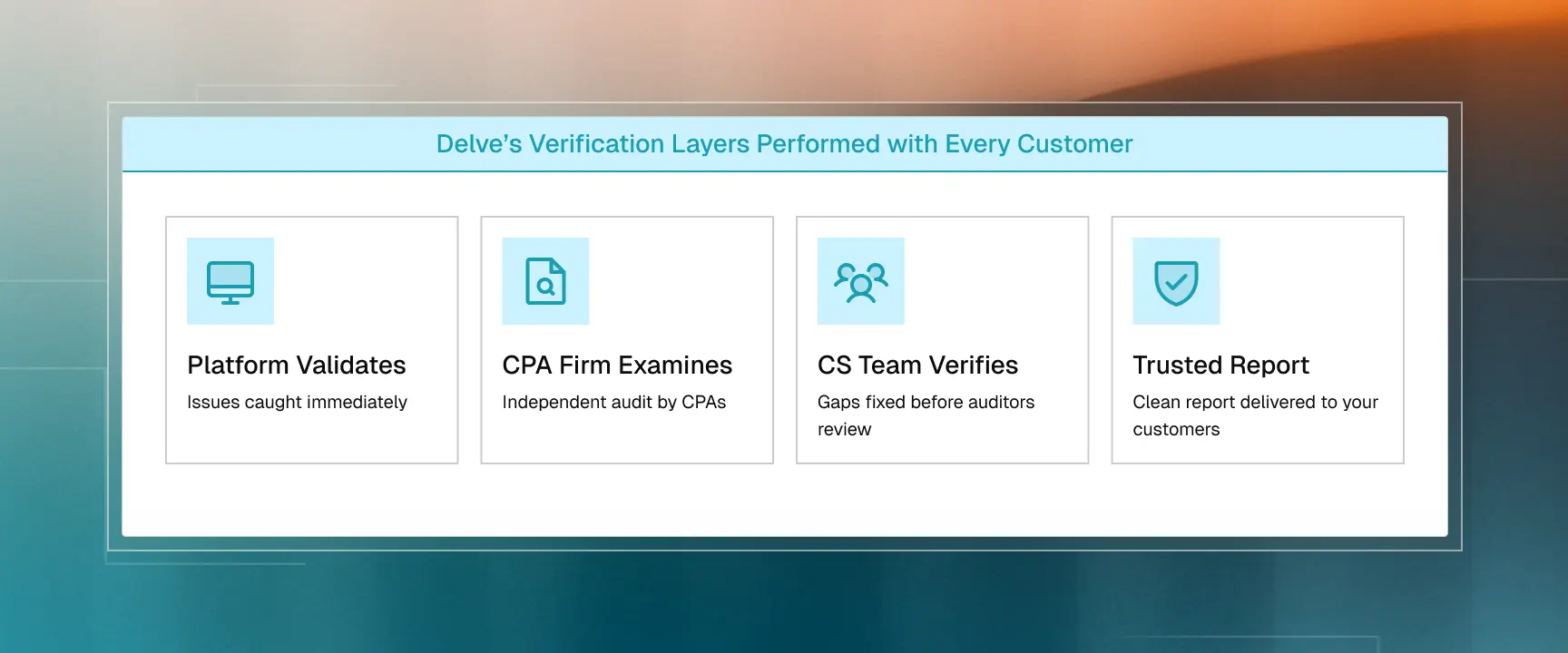
Every Delve engagement is built on three layers of trust. (1) The Delve platform runs automated checks across your systems, (2) a dedicated team member reviews everything by hand, and (3) an independent firm completes the final examination.
- Before an auditor ever gets involved, Delve’s team validates your compliance posture. Experts review network diagrams, asset inventories, access controls, vulnerability scans, and policies so there are no surprises during the audit.
- The final audit is always performed by a trusted firm. Delve works with a vetted network of independent auditors, and customers can also bring their own auditor if preferred.
- Under the hood, Delve applies state of the art technology to make this process possible, with AI that continuously analyzes evidence, flags gaps, and reduces manual back and forth.
No two audit reports are the same. Delve assists customers in tailoring the compliance process to your company’s security standards, operational practices (e.g. org chart), and infrastructure (e.g. network diagram).
This layered approach is how Delve sets the standard for trust and security. Our compliance process has helped customers pass enterprise reviews by the Fortune 500s, leading financial institutions, and federal bodies. Delve supports compliance from SOC 2 through the most demanding regulatory frameworks, such as FedRAMP.
Your security-conscious customers will read your SOC 2 audit or any other compliance report carefully. They will check who signed it. They will look for exceptions. They will ask whether your auditor actually tested controls or just reviewed screenshots.
Delve's trusted compliance process is built for that scrutiny, with three verification layers aligned with industry recognized security control frameworks and evidence validated before auditors ever see it.
Three questions every procurement team asks
When enterprise security teams evaluate your compliance report, they ask three questions:
- Is the auditor legitimate? They check whether your firm is licensed and experienced with technology companies.
- Is the evidence real? They want proof that controls were in place throughout the observation period. Logs, configurations, and tested samples are what they trust.
- Was the process honest? They look for missing documentation, exceptions without remediation, and other signs for a lack of integrity.
At Delve, we've designed our compliance process to answer all three confidently.
What happens before your audit begins
Most compliance platforms hand you a dashboard, give a list of auditors, and wish you luck. You trigger the audit, cross your fingers, and hope nothing is missing. Delve works differently. Your evidence passes through three independent verification layers.
1. The Platform Validates
When you connect your cloud infrastructure, identity providers, and code repositories, the platform does not just collect evidence. It checks that evidence against cloud security best practices.
AI validation runs analysis on every upload. Screenshots get matched against the controls they claim to satisfy. Policy documents get scanned for required sections. Access logs get verified for correct permissions. Drift gets flagged immediately, not during audit fieldwork when it becomes an exception.
The platform also builds your Section 3 system description, the detailed narrative auditors require about your product, data flows, and infrastructure scope.
2. Delve's Team Verifies
Before your audit triggers, a Delve team member conducts a full review.
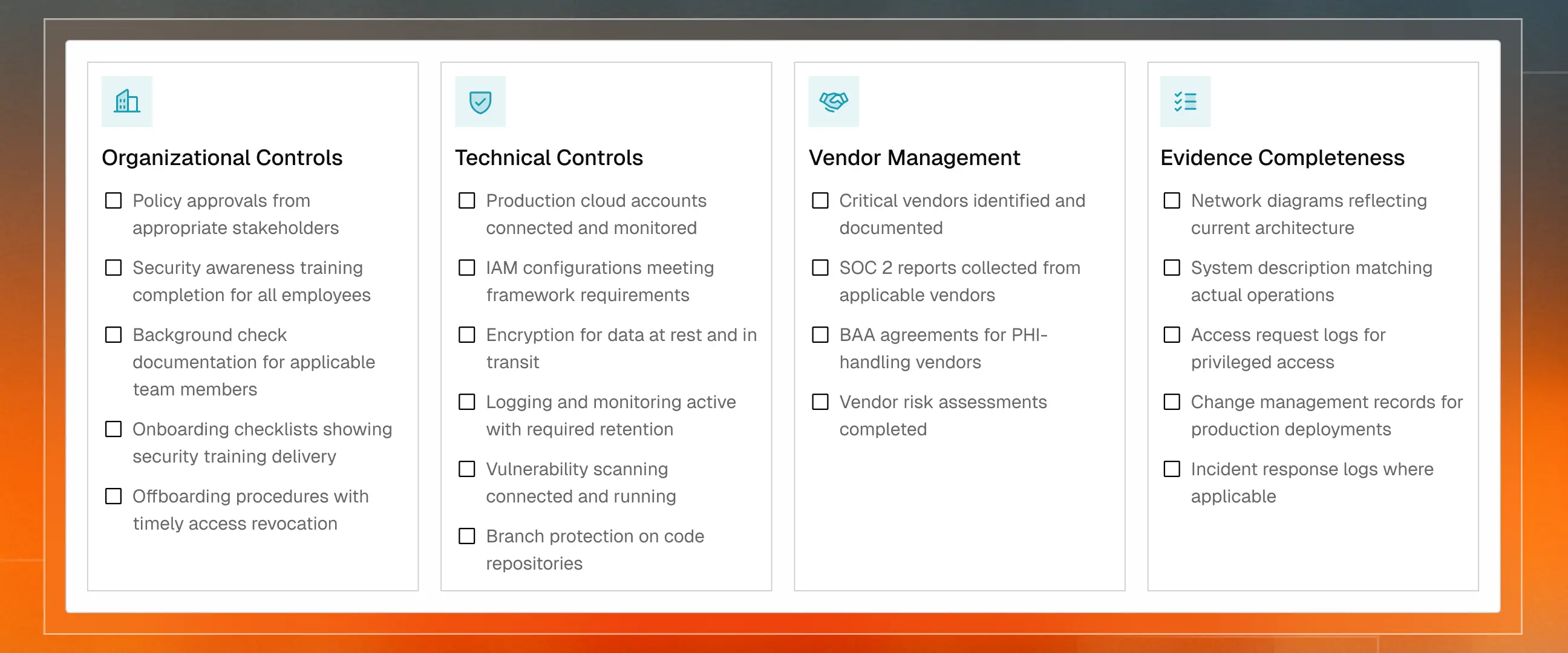
They check policy approvals, technical integrations, cloud configurations against cloud provider security standards, vendor documentation, BAA agreements, network diagrams, access request logs, and vulnerability scanning results. If anything is missing or misconfigured, you fix it before the auditor arrives.
This layer exists because we have seen what happens without it. Companies rush into audits unprepared. They get exceptions. They spend weeks in a back-and-forth. They miss their deal deadlines.
See how Bland AI avoided this issue and unlocked $500,000 in contracts.
3. The Auditor Examines
The final layer is the independent firm that signs your report. Their professional obligation is to provide honest opinions about your controls.
Auditors do not work for Delve. They work for you. We provide efficiency. Structured evidence means faster reviews. Pre-verified completeness means less back-and-forth. AI validation means auditors focus on substantive testing, not administrative cleanup.
The AI-native Delve platform’s competitive advantage
Legacy compliance platforms treat AI as a feature. A checkbox on a marketing page. A chatbot that answers basic questions. The core workflow remains manual. Evidence still requires human collection and review. Policy analysis still takes hours.
Delve is AI-native. The platform was architected around AI from the start, with workflows and interactions designed around AI to improve compliance posture.
Here is what that means in practice:
- Evidence never reaches auditors unvalidated. AI checks every upload before submission. Screenshots get matched against the controls they claim to satisfy. Policies get scanned for required language. Gaps get flagged before they become audit exceptions. This pre-validation is why auditors trust Delve evidence and move faster through fieldwork.
- Compliance testing runs continuously. Not weekly. Not monthly. Daily. Drift gets caught immediately. Issues get resolved before auditors arrive.
- AI also supports auditors directly. Delve’s AI policy chat gives auditors human-grade rigor without human margin for error, consistently surfacing gaps and inconsistencies that would otherwise be missed.
This is how we've helped companies like 11x save 143 hours in manual compliance work and unlock $2.3M in enterprise contracts after switching from a platform that took four months just to get Type I compliant.
Pre-audit readiness: How Delve's team validates your evidence
The reason Delve customers rarely see audit exceptions is that a comprehensive human review occurs before any audit triggers. Most audit exceptions come from the same place: evidence gaps nobody caught until fieldwork. A missing policy approval. An employee who skipped training. A staging database that was connected instead of production. Small oversights can become formal findings.
Delve's team does not just check boxes. They open your integrations. They verify SOC 2 reports were uploaded for subservice organizations in scope. They confirm that all employees are accounted for and have completed training.
When HockeyStack needed to migrate from their previous compliance platform during a critical growth inflection, Delve's team handled the entire transfer of compliance data. Beyond scheduled checkpoints, Delve's team routinely stepped in to answer security questionnaires, field ad hoc compliance questions, and manage challenging vendor reviews.
This depth of review is why Delve customers rarely see audit exceptions. By the time an auditor begins their work, the evidence is already human- and AI-verified.
Partnering with vetted firms
The wrong auditor slows everything down. They request evidence in unfamiliar formats. They surface exceptions in the draft report instead of during fieldwork, when you could still address them.
Delve's audit partner network eliminates these problems. All with corresponding licenses. All with technology company expertise. All familiar with the Delve platform. Every auditor in our network meets strict criteria:
- Licensed firm in good standing
- Experience with cloud-native technology companies
- Familiarity with our platform and evidence structure
- Reasonable timelines without sacrificing thoroughness
We work closely with our audit partners to ensure they have evidence exactly as they need it. Auditors can open JSON logs from your integrations, verify that you connected to production (not staging), and confirm that all employees are accounted for. This access builds auditor confidence and eliminates guesswork.
Platform familiarity is the difference between a 3-week audit and a 12-week audit. Auditors who know Delve navigate directly to evidence. They understand our control mapping. No reformatted exports. No redundant questions.
Wispr completed compliance in two phases, first establishing controls and training across their full tech stack, then completing the audit with minimal back and forth. As a result, they passed enterprise reviews and closed customers including Mercury, Superhuman, and multiple Fortune 500 companies.
Our audit partners also communicate openly. If they spot a potential exception during fieldwork, you hear about it immediately. Not when the draft arrives. That early warning gives you time to provide context, surface compensating controls, or remediate before it becomes a formal finding.
Control failures: what do auditors actually care about
The most common question from companies mid-observation is, “If a control fails, does the clock reset?” It does not.
Compliance audits produce opinions or attestations, not pass/fail grades. What matters is whether your overall control environment meets the framework's criteria, not whether you achieved perfection.
A single control exception does not force a negative outcome. Auditors evaluate three factors: the severity of the exception, the scope of the impact, and the quality of your response.
When exceptions occur, auditors document them in their findings. You respond with context and remediation. Minor exceptions with compensating controls and clear fixes routinely result in clean opinions.
Delve's continuous monitoring shifts this dynamic. Control drift surfaces immediately. You remediate before issues compound. Your response is documented automatically. When auditors review evidence, they see the full picture: exception, detection, and resolution.
Enterprise customers reading your report see this too. A minor exception handled well can even signal a stronger security posture than a perfect report. It demonstrates that monitoring catches issues and your team responds.
HockeyStack's penetration test identified vulnerabilities, including access control issues, insufficient rate limiting, and session management concerns. Their engineering team, working with Delve's security experts, remediated all findings within the same sprint cycle. This rapid response demonstrated that HockeyStack takes security seriously and has the processes in place to address issues swiftly.
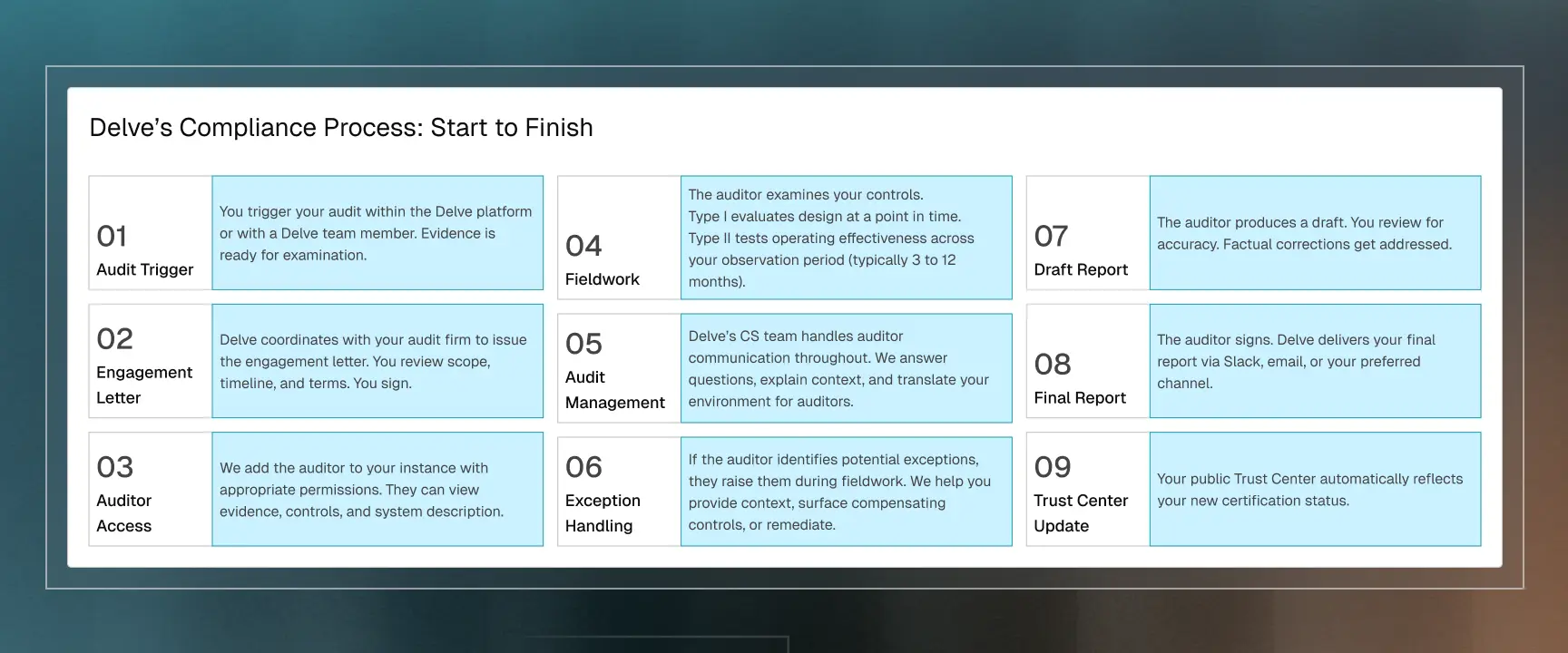
Delve’s compliance process: Start to finish
Here is what happens once you are ready to begin your audit.
Trust Center: Sharing your reports
You have your signed report in hand. Now what?
Delve’s Trust Report gives you a single place to manage and share your compliance posture. Instead of emailing sensitive audit documents or deciding what each prospect can see, you control how trust is presented, what stays protected, and how access is granted as deals move forward.
- Delve's Trust Report manages all compliance documents in one place. Delve provides a public Trust Report where you display compliance status without needing to share your detailed report. Visitors can see your certifications, reporting dates, and addressed frameworks. They request full documentation through a built-in NDA workflow or custom data room. No email chains. No manual tracking. Wispr onboarded 400 enterprises in two months using their Trust Center.
- NDA workflows. Most companies prefer to share detailed compliance reports under non-disclosure agreements. Delve handles the NDA flow end-to-end, all built into the Trust Report.
- Dynamic badge management. When you receive an audit report, your Trust Report updates to reflect that. If your compliance report expires, your compliance badge is removed.
- Public-facing options. Some frameworks offer public versions of compliance reports. SOC 3 reports include the auditor's opinion and a general description of the system, but do not include detailed test results. ISO 27001 certificates can be shared freely. Through your Trust Report, you can decide which reports to hide behind NDA workflows or share publicly.
How Delve handles edge cases
Not every company fits the standard compliance template. You might be two founders with no employees. You might not have hired anyone in six months. Your team might be 80% contractors on personal laptops. These are not disqualifiers. They are context.
Delve customers have completed hundreds of audits. We have seen many customer variations and know how to translate your reality for auditors. Remi, a company in the roofing industry, needed to support deep partner integrations, including embedding services into CRMs with sensitive customer data. Delve helped translate that environment into audit ready controls, resulting in both Type I and Type II certifications and significantly shorter security reviews.
Maintaining your security post-certification
Your signed report is a milestone, not a finish line for Delve.
Delve keeps monitoring. Daily compliance tests continue running. When controls drift, Delve flags them before small issues become audit problems.
Delve manages your renewal. We track your timeline, maintain evidence collection year-round, and remind you when it's time for your next audit. Renewal is faster because gaps are monitored for.
Delve maps your next framework. When you need SOC 2, ISO 27001, HIPAA, or CMMC, we show which controls already satisfy new requirements. You build on what you have proven, not from scratch.
Delve powers your sales. Your Trust Report stays current. AI-assisted questionnaire responses and structured data rooms turn compliance into a deal-closer.
Delve helps you improve. Our team reviews your audit reports for findings, provides suggestions for improvement, and tracks progress through the platform.
Certification is where Delve's partnership begins, not where it ends.
About the authors


Summary
Every Delve engagement is built on three layers of trust. (1) The Delve platform runs automated checks across your systems, (2) a dedicated team member reviews everything by hand, and (3) an independent firm completes the final examination.
- Before an auditor ever gets involved, Delve’s team validates your compliance posture. Experts review network diagrams, asset inventories, access controls, vulnerability scans, and policies so there are no surprises during the audit.
- The final audit is always performed by a trusted firm. Delve works with a vetted network of independent auditors, and customers can also bring their own auditor if preferred.
- Under the hood, Delve applies state of the art technology to make this process possible, with AI that continuously analyzes evidence, flags gaps, and reduces manual back and forth.
No two audit reports are the same. Delve assists customers in tailoring the compliance process to your company’s security standards, operational practices (e.g. org chart), and infrastructure (e.g. network diagram).
This layered approach is how Delve sets the standard for trust and security. Our compliance process has helped customers pass enterprise reviews by the Fortune 500s, leading financial institutions, and federal bodies. Delve supports compliance from SOC 2 through the most demanding regulatory frameworks, such as FedRAMP.
Your security-conscious customers will read your SOC 2 audit or any other compliance report carefully. They will check who signed it. They will look for exceptions. They will ask whether your auditor actually tested controls or just reviewed screenshots.
Delve's trusted compliance process is built for that scrutiny, with three verification layers aligned with industry recognized security control frameworks and evidence validated before auditors ever see it.
Three questions every procurement team asks
When enterprise security teams evaluate your compliance report, they ask three questions:
- Is the auditor legitimate? They check whether your firm is licensed and experienced with technology companies.
- Is the evidence real? They want proof that controls were in place throughout the observation period. Logs, configurations, and tested samples are what they trust.
- Was the process honest? They look for missing documentation, exceptions without remediation, and other signs for a lack of integrity.
At Delve, we've designed our compliance process to answer all three confidently.
What happens before your audit begins
Most compliance platforms hand you a dashboard, give a list of auditors, and wish you luck. You trigger the audit, cross your fingers, and hope nothing is missing. Delve works differently. Your evidence passes through three independent verification layers.
1. The Platform Validates
When you connect your cloud infrastructure, identity providers, and code repositories, the platform does not just collect evidence. It checks that evidence against cloud security best practices.
AI validation runs analysis on every upload. Screenshots get matched against the controls they claim to satisfy. Policy documents get scanned for required sections. Access logs get verified for correct permissions. Drift gets flagged immediately, not during audit fieldwork when it becomes an exception.
The platform also builds your Section 3 system description, the detailed narrative auditors require about your product, data flows, and infrastructure scope.
2. Delve's Team Verifies
Before your audit triggers, a Delve team member conducts a full review.
They check policy approvals, technical integrations, cloud configurations against cloud provider security standards, vendor documentation, BAA agreements, network diagrams, access request logs, and vulnerability scanning results. If anything is missing or misconfigured, you fix it before the auditor arrives.
This layer exists because we have seen what happens without it. Companies rush into audits unprepared. They get exceptions. They spend weeks in a back-and-forth. They miss their deal deadlines.
See how Bland AI avoided this issue and unlocked $500,000 in contracts.
3. The Auditor Examines
The final layer is the independent firm that signs your report. Their professional obligation is to provide honest opinions about your controls.
Auditors do not work for Delve. They work for you. We provide efficiency. Structured evidence means faster reviews. Pre-verified completeness means less back-and-forth. AI validation means auditors focus on substantive testing, not administrative cleanup.
The AI-native Delve platform’s competitive advantage
Legacy compliance platforms treat AI as a feature. A checkbox on a marketing page. A chatbot that answers basic questions. The core workflow remains manual. Evidence still requires human collection and review. Policy analysis still takes hours.
Delve is AI-native. The platform was architected around AI from the start, with workflows and interactions designed around AI to improve compliance posture.
Here is what that means in practice:
- Evidence never reaches auditors unvalidated. AI checks every upload before submission. Screenshots get matched against the controls they claim to satisfy. Policies get scanned for required language. Gaps get flagged before they become audit exceptions. This pre-validation is why auditors trust Delve evidence and move faster through fieldwork.
- Compliance testing runs continuously. Not weekly. Not monthly. Daily. Drift gets caught immediately. Issues get resolved before auditors arrive.
- AI also supports auditors directly. Delve’s AI policy chat gives auditors human-grade rigor without human margin for error, consistently surfacing gaps and inconsistencies that would otherwise be missed.
This is how we've helped companies like 11x save 143 hours in manual compliance work and unlock $2.3M in enterprise contracts after switching from a platform that took four months just to get Type I compliant.
Pre-audit readiness: How Delve's team validates your evidence
The reason Delve customers rarely see audit exceptions is that a comprehensive human review occurs before any audit triggers. Most audit exceptions come from the same place: evidence gaps nobody caught until fieldwork. A missing policy approval. An employee who skipped training. A staging database that was connected instead of production. Small oversights can become formal findings.
Delve's team does not just check boxes. They open your integrations. They verify SOC 2 reports were uploaded for subservice organizations in scope. They confirm that all employees are accounted for and have completed training.
When HockeyStack needed to migrate from their previous compliance platform during a critical growth inflection, Delve's team handled the entire transfer of compliance data. Beyond scheduled checkpoints, Delve's team routinely stepped in to answer security questionnaires, field ad hoc compliance questions, and manage challenging vendor reviews.
This depth of review is why Delve customers rarely see audit exceptions. By the time an auditor begins their work, the evidence is already human- and AI-verified.
Partnering with vetted firms
The wrong auditor slows everything down. They request evidence in unfamiliar formats. They surface exceptions in the draft report instead of during fieldwork, when you could still address them.
Delve's audit partner network eliminates these problems. All with corresponding licenses. All with technology company expertise. All familiar with the Delve platform. Every auditor in our network meets strict criteria:
- Licensed firm in good standing
- Experience with cloud-native technology companies
- Familiarity with our platform and evidence structure
- Reasonable timelines without sacrificing thoroughness
We work closely with our audit partners to ensure they have evidence exactly as they need it. Auditors can open JSON logs from your integrations, verify that you connected to production (not staging), and confirm that all employees are accounted for. This access builds auditor confidence and eliminates guesswork.
Platform familiarity is the difference between a 3-week audit and a 12-week audit. Auditors who know Delve navigate directly to evidence. They understand our control mapping. No reformatted exports. No redundant questions.
Wispr completed compliance in two phases, first establishing controls and training across their full tech stack, then completing the audit with minimal back and forth. As a result, they passed enterprise reviews and closed customers including Mercury, Superhuman, and multiple Fortune 500 companies.
Our audit partners also communicate openly. If they spot a potential exception during fieldwork, you hear about it immediately. Not when the draft arrives. That early warning gives you time to provide context, surface compensating controls, or remediate before it becomes a formal finding.
Control failures: what do auditors actually care about
The most common question from companies mid-observation is, “If a control fails, does the clock reset?” It does not.
Compliance audits produce opinions or attestations, not pass/fail grades. What matters is whether your overall control environment meets the framework's criteria, not whether you achieved perfection.
A single control exception does not force a negative outcome. Auditors evaluate three factors: the severity of the exception, the scope of the impact, and the quality of your response.
When exceptions occur, auditors document them in their findings. You respond with context and remediation. Minor exceptions with compensating controls and clear fixes routinely result in clean opinions.
Delve's continuous monitoring shifts this dynamic. Control drift surfaces immediately. You remediate before issues compound. Your response is documented automatically. When auditors review evidence, they see the full picture: exception, detection, and resolution.
Enterprise customers reading your report see this too. A minor exception handled well can even signal a stronger security posture than a perfect report. It demonstrates that monitoring catches issues and your team responds.
HockeyStack's penetration test identified vulnerabilities, including access control issues, insufficient rate limiting, and session management concerns. Their engineering team, working with Delve's security experts, remediated all findings within the same sprint cycle. This rapid response demonstrated that HockeyStack takes security seriously and has the processes in place to address issues swiftly.
Delve’s compliance process: Start to finish
Here is what happens once you are ready to begin your audit.
Trust Center: Sharing your reports
You have your signed report in hand. Now what?
Delve’s Trust Report gives you a single place to manage and share your compliance posture. Instead of emailing sensitive audit documents or deciding what each prospect can see, you control how trust is presented, what stays protected, and how access is granted as deals move forward.
- Delve's Trust Report manages all compliance documents in one place. Delve provides a public Trust Report where you display compliance status without needing to share your detailed report. Visitors can see your certifications, reporting dates, and addressed frameworks. They request full documentation through a built-in NDA workflow or custom data room. No email chains. No manual tracking. Wispr onboarded 400 enterprises in two months using their Trust Center.
- NDA workflows. Most companies prefer to share detailed compliance reports under non-disclosure agreements. Delve handles the NDA flow end-to-end, all built into the Trust Report.
- Dynamic badge management. When you receive an audit report, your Trust Report updates to reflect that. If your compliance report expires, your compliance badge is removed.
- Public-facing options. Some frameworks offer public versions of compliance reports. SOC 3 reports include the auditor's opinion and a general description of the system, but do not include detailed test results. ISO 27001 certificates can be shared freely. Through your Trust Report, you can decide which reports to hide behind NDA workflows or share publicly.
How Delve handles edge cases
Not every company fits the standard compliance template. You might be two founders with no employees. You might not have hired anyone in six months. Your team might be 80% contractors on personal laptops. These are not disqualifiers. They are context.
Delve customers have completed hundreds of audits. We have seen many customer variations and know how to translate your reality for auditors. Remi, a company in the roofing industry, needed to support deep partner integrations, including embedding services into CRMs with sensitive customer data. Delve helped translate that environment into audit ready controls, resulting in both Type I and Type II certifications and significantly shorter security reviews.
Maintaining your security post-certification
Your signed report is a milestone, not a finish line for Delve.
Delve keeps monitoring. Daily compliance tests continue running. When controls drift, Delve flags them before small issues become audit problems.
Delve manages your renewal. We track your timeline, maintain evidence collection year-round, and remind you when it's time for your next audit. Renewal is faster because gaps are monitored for.
Delve maps your next framework. When you need SOC 2, ISO 27001, HIPAA, or CMMC, we show which controls already satisfy new requirements. You build on what you have proven, not from scratch.
Delve powers your sales. Your Trust Report stays current. AI-assisted questionnaire responses and structured data rooms turn compliance into a deal-closer.
Delve helps you improve. Our team reviews your audit reports for findings, provides suggestions for improvement, and tracks progress through the platform.
Certification is where Delve's partnership begins, not where it ends.
21-year-old MIT dropouts raise $32M at $300M valuation led by Insight

Related Posts



Don't let manual compliance slow you down.


.avif)





.webp)