

Key Takeaways
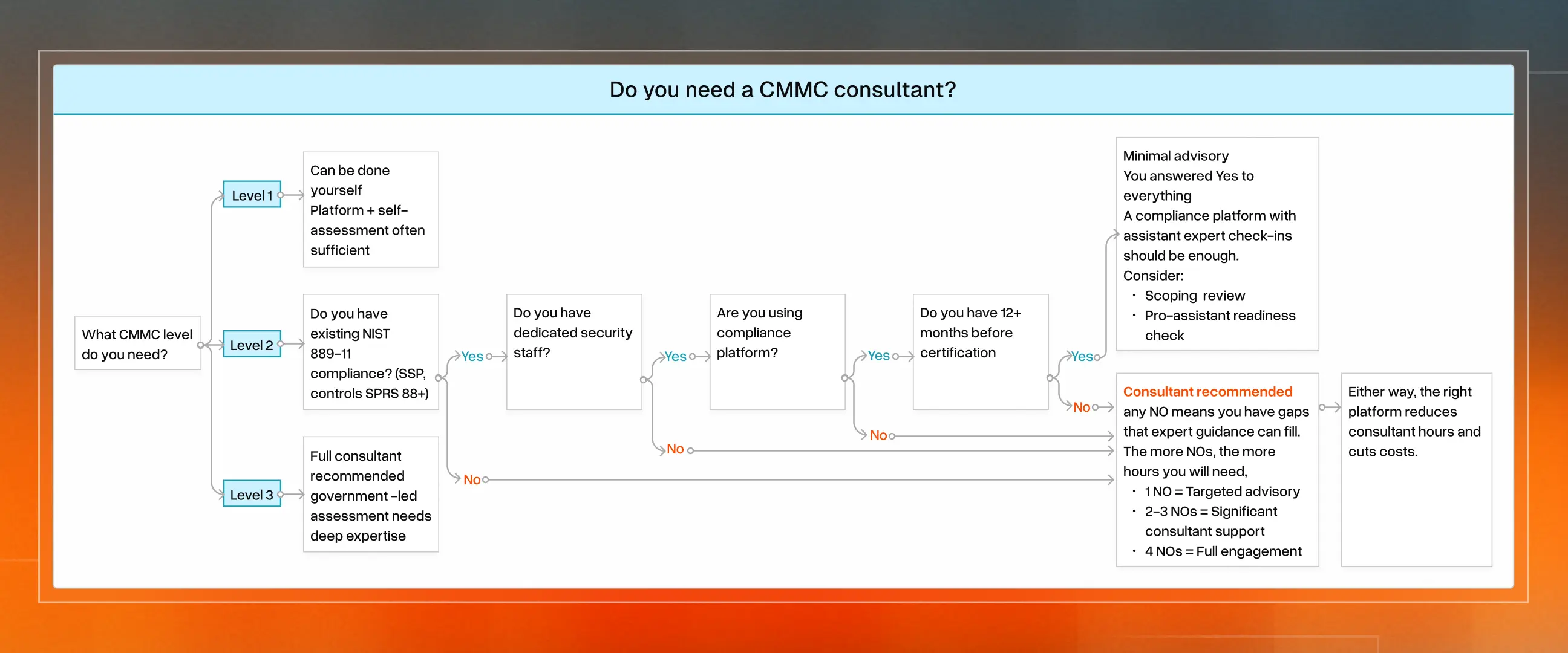
- CMMC consultant requirements depend on your certification level. Level 1 (basic contracts) can typically be achieved independently. Level 2 (handling sensitive defense data) requires expert support for gap assessment, documentation, and C3PAO audit preparation. Level 3 (critical programs) strongly recommends full engagement of consultants.
- Consultants handle scoping, gap analysis, documentation, remediation guidance, and audit prep. They cannot assess you (conflict of interest rule).
- You may need less consultant support if you have existing NIST 800-171 compliance, dedicated security staff, or a compliance automation platform.
- The smartest approach combines platform automation with targeted expert advisory. Platforms like Delve handle evidence collection, documentation, and monitoring. Consultants handle scoping, complex remediation, and assessment prep. Technology handles the grind; experts handle the judgment calls.
CMMC Level 2 demands mastery of 110 security controls across 320 assessment objectives. Yet the average defense contractor is an engineering firm, a manufacturer, or a software company. They build products, not compliance programs. This expertise gap makes CMMC consultants unavoidable. For most Level 2 contractors, consultant involvement is not legally required, but is operationally difficult to avoid.
With CMMC Phase 1 already in effect and Level 2 certification typically requiring 12-24 months to achieve, the decision about consultant support is not theoretical.
The real cost of CMMC failure is not consulting fees; it is delayed awards, lost recompetes, and disqualification from future programs.
Understanding the CMMC Certification Objective
CMMC is designed to protect Controlled Unclassified Information (CUI) across the defense supply chain. The business reality is straightforward: no certification means no contract award. This is not an optional security improvement. It is a gatekeeping requirement for doing business with the Department of Defense.
The framework breaks into three levels.
- Level 1 covers Federal Contract Information (FCI), which is information generated under a federal contract that is not public, with 17 practices and an annual self-assessment.
- Level 2 addresses CUI with 110 controls aligned with NIST SP 800-171, requiring third-party C3PAO assessment for most contractors handling sensitive defense information.
- Level 3 adds enhanced controls from NIST SP 800-172 for high-value CUI at risk of advanced persistent threats, requiring government-led DIBCAC assessment.
Phase 1 went live on November 10, 2025.CMMC requirements are being phased into DoD contracts following publication of the final rule, with early adoption beginning in FY2025 and broader enforcement expected through FY2026. Phase 2, which requires C3PAO assessments for prioritized acquisitions, begins in November 2026. The level you need, and whether self-assessment or third-party certification applies, directly determines how much consultant support makes sense for your organization.
What a CMMC Consultant Actually Does
Scoping and Gap Assessment
The most critical (and commonly botched) consultant deliverable is scoping. This means defining your CUI boundary: what systems, people, and processes handle controlled information and therefore fall within your compliance perimeter. Poor scoping inflates cost and complexity exponentially. Good scoping can dramatically reduce both, including evaluating whether an enclave strategy that isolates CUI in a dedicated secure environment like Microsoft GCC High is one possible strategy, not a requirement, and should be evaluated against cost, data flow, and operational impact.
From there, consultants evaluate your current posture against 320 assessment objectives that inform the 110 controls, calculate your accurate SPRS score (the DoD's contractor risk scoring database) using official methodology, and identify precisely where you fall short. This gap analysis becomes the foundation for everything that follows.
Documentation and Remediation
CMMC certification requires substantial documentation: a System Security Plan (SSP) describing how your organization implements each security control; a Plan of Action and Milestones (POA&M) tracking remediation of identified gaps; and policies and procedures aligned with each of the 14 control families. Consultants develop these artifacts and provide remediation guidance, translating abstract control requirements into concrete implementation steps your team can execute.
Audit Preparation and Support
Before your formal assessment, consultants conduct mock assessments and readiness reviews, organize evidence for C3PAO submission into the required format, and coach your staff on interview techniques. Assessors will ask pointed questions about how controls are implemented, and your team needs to answer confidently. During the actual assessment, many consultants provide "at the elbow" support, helping you respond to assessor questions and locate evidence in real time.
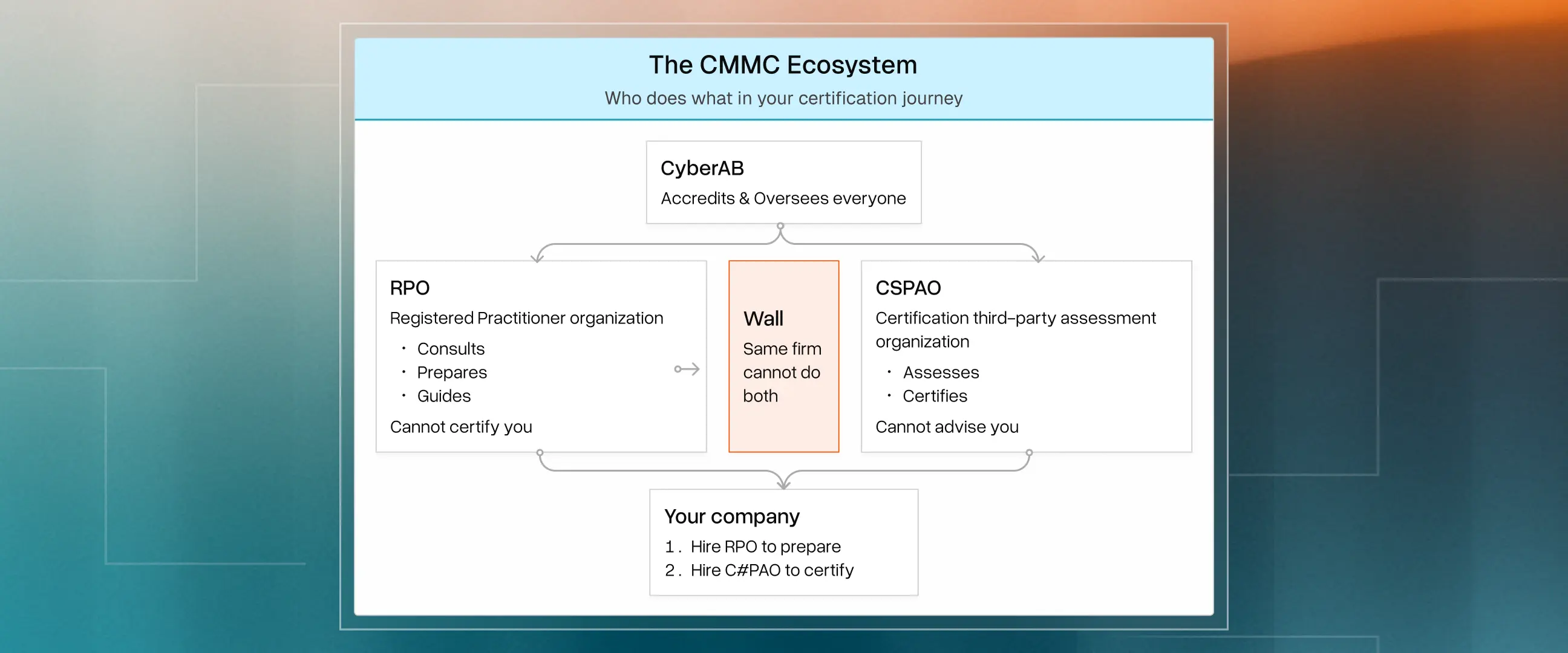
Key Distinction: RPO vs C3PAO. A Registered Practitioner Organization (RPO) consults, prepares, and guides you toward certification. A Certified Third-Party Assessment Organization (C3PAO) conducts the official assessment and issues certification. The same organization cannot serve as both your consultant and your assessor. CyberAB enforces this conflict-of-interest protection as the official CMMC accreditation body.
When Do You Need a CMMC Consultant
Strong Indicators
- No dedicated security staff: Cybersecurity is a side responsibility for your IT team, not a primary function with dedicated headcount.
- First time through CMMC: No prior NIST 800-171 compliance work, no existing SSP, starting from scratch.
- Complex IT environment: Multi-cloud infrastructure, multiple physical locations, custom applications touching CUI.
- Aggressive contract timeline: Certification needed within 6-12 months to meet contract requirements.
- Scoping uncertainty: Unclear where CUI lives in your environment, how it flows between systems, or what actually touches it.
Non-Negotiable Scenarios
- Handling defense-related CUI: Technical data, engineering drawings, or documents with restricted distribution markings (the kind that say 'not approved for public release'). This automatically requires C3PAO assessment, and consultant preparation becomes nearly essential.
- Prime contractor mandate: Your prime is requiring CMMC certification as a subcontract condition with a specific deadline per DFARS 252.204-7021
- SPRS score below 88: 5-point and 3-point controls necessarily have to be in place. You cannot achieve even conditional certification without significant remediation. Low SPRS scores typically indicate missing 3- and 5-point controls, which are ineligible for POA&Ms and must be remediated prior to certification. Expert guidance prioritizes appropriate controls, accelerates gap closure and prevents costly missteps.
- POA&M under 180-day clock: Conditional certification requires completing all remediation within 180 days. Mistakes reset the clock and jeopardize contract eligibility entirely.
When You Might Not Need a Full Consultant
Not every contractor requires a full consulting engagement. Here are scenarios where dependency is legitimately lower:
- Level 1 certification only: Fewer practices, annual self-assessment, significantly less complex than Level 2.
- Already NIST 800-171 compliant: Have existing System Security Plan, mature controls, high SPRS score. You are validating what you have already built, not starting from scratch.
- Strong internal cybersecurity team: Dedicated security personnel with compliance experience and actual bandwidth to own the process.
- Using compliance automation platforms: Tools like Delve that handle evidence collection, documentation generation, and continuous monitoring, reducing the manual work consultants typically perform.
Even in these scenarios, targeted advisory hours often prove valuable. Consider a vCISO engagement for strategic oversight, providing a readiness review before your C3PAO assessment, or scoping validation to confirm you have not missed CUI boundaries. The question shifts from "do I need a consultant?" to "how many consultant hours do I actually need?"
What CMMC Consultants Typically Cost
According to DoD estimates, small defense contractors (under 500 employees or $7.5M revenue) would incur approximately $100,293 in Level 2 C3PAO certification over a three-year cycle. Here is how that breaks down:
Source: DoD 32 CFR Final Rule Economic Analysis
These figures include both internal staff time and external service providers such as consultants, Registered Practitioners, and C3PAOs. The critical insight from the DoD's economic analysis: a heavy reliance on external consultants can increase preparation costs by 50-100% compared with organisations that leverage internal resources and automation tools like Delve. The inverse is also true. Effective platforms and internal capability dramatically reduce external spend.
How to Choose the Right CMMC Consultant
If you determine you need consultant support, verification matters:
- Check the CyberAB Marketplace to confirm the organization is a registered RPO. If they are not listed, they are not authorized to provide CMMC consulting services.
- Verify individual credentials. Look for Registered Practitioners (RP), Certified CMMC Professionals (CCP), or Certified CMMC Assessors (CCA) on staff through the CyberAB Individual Directory. Note: CCAs should not consult on environments they may later assess, even if permitted elsewhere, to avoid audit challenges.
- Ask about small business experience. Consultants who specialize in small business defense contractors understand resource constraints and will not over-engineer solutions.
- Request success metrics. C3PAO pass rates, time-to-certification averages, and client references from similar-sized organizations.
- Confirm assessment methodology. Do they use interview, examination, and test methods aligned with NIST 800-171A? This is precisely how C3PAOs will evaluate you.
- Understand the conflict of interest rule. If a firm offers both consulting and assessment services, it cannot perform both for the same client per CyberAB ethics requirements.
Consider vCISO services as an alternative model. This provides ongoing security leadership at a fraction of the cost of a full-time CISO and is often more sustainable than project-based consulting for organisations needing continuous compliance support.
The Third Option: Platform-Assisted Compliance
The traditional decision looks binary: DIY (high effort, high failure risk, requires expertise you likely do not have) versus full consultant engagement (high cost, external dependency, paying expert rates for manual work). But there is an emerging third path that is changing the calculus: AI-native compliance platforms combined with targeted expert advisory.
What Platforms Automate vs. What Requires Human Expertise
The result is that consultant hours shift to targeted advisory (scoping, complex remediation, assessment prep), while the platform handles operational lift. You get expert guidance where it matters most without paying consultant rates for work that automation handles better and faster.
AI-native platforms like Delve are built for exactly this model. Streamlined workflows reduce the time consultants spend on your engagement. Automated evidence collection eliminates tedious manual screenshot gathering. End-to-end audit management minimizes back-and-forth with assessors. The platform handles the grind; consultants handle the judgment calls.
The question then becomes "how much consultant support do I actually need?" instead of “Do I need a consultant for CMMC certification?”
If you are pursuing Level 2 certification, the wrong mix of tooling and advisory support can cost you a year.
Talk to our team about getting audit-ready with AI-native compliance and significantly cut down your consultant costs.
About the authors

Richard Selvidge is a cybersecurity engineer with more than 25 years of experience spanning the Department of Defense, critical infrastructure, and the commercial sector. He has served in roles from hands-on technical operations to strategic leadership, including work inside top-secret national laboratories where advanced cyber-defense capabilities and high-stakes mission support were the norm.




Don't let manual compliance slow you down.