



Summary
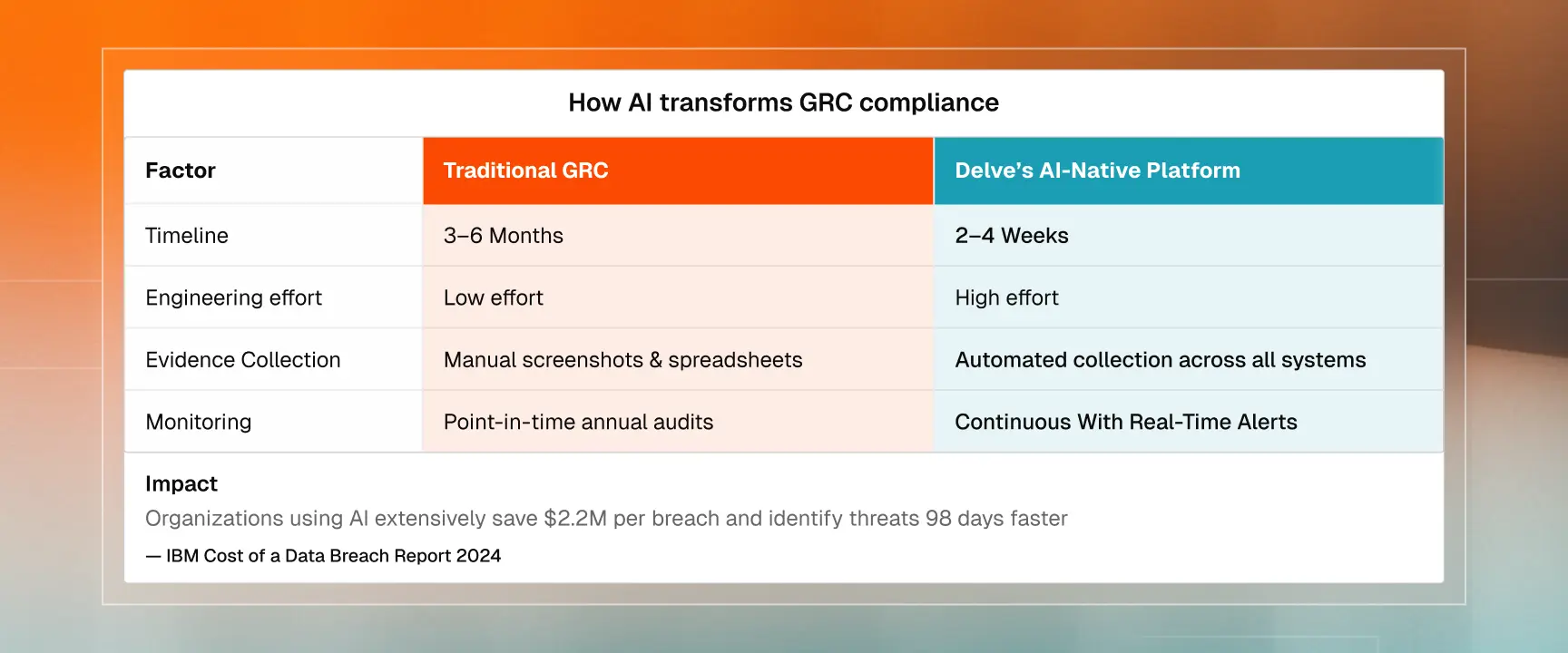
- AI transforms GRC compliance in 2026 through automated evidence collection, continuous control monitoring, and predictive risk analysis. Organizations that deploy these capabilities save $2.2 million per breach while cutting threat detection time by 98 days.
- Gartner forecasts 50% growth in GRC tool investment by 2026 as regulatory complexity outpaces manual compliance capabilities.
- The EU AI Act introduces mandatory risk assessments, transparency requirements, and governance controls for high-risk AI systems starting August 2026, alongside NIST AI RMF and ISO 42001 frameworks.
- Modern GRC shifts compliance from periodic checkbox exercises to continuous security posture management with real-time drift detection.
Artificial intelligence is fundamentally reshaping how organizations approach governance, risk, and compliance in 2026. AI-native GRC platforms compress certification timelines from months to weeks while improving control effectiveness and audit accuracy. This transformation matters because compliance is accelerating beyond human bandwidth.
According to Gartner, legal and compliance departments will increase their investment in GRC tools by 50% by 2026. For organizations building B2B SaaS products, the question is no longer whether to automate compliance but how to implement AI-driven workflows that scale with your business.
Why Traditional GRC Is Breaking Down
The manual compliance model was designed for a slower world. Point-in-time audits, spreadsheet-based evidence tracking, and periodic risk assessments created visibility gaps that allowed threats to emerge undetected.
The lag between threat emergence and detection is where manual processes fail most critically.
GRC professionals view AI adoption as both an opportunity and a challenge, noting that its potential to transform decision-making is too significant to ignore. For organizations pursuing enterprise deals, this gap creates immediate business risk. When procurement requests your SOC 2 report and you are still gathering evidence manually, deals stall. AI-driven automation addresses this directly.
AI-Powered GRC Platforms Core Capabilities in 2026
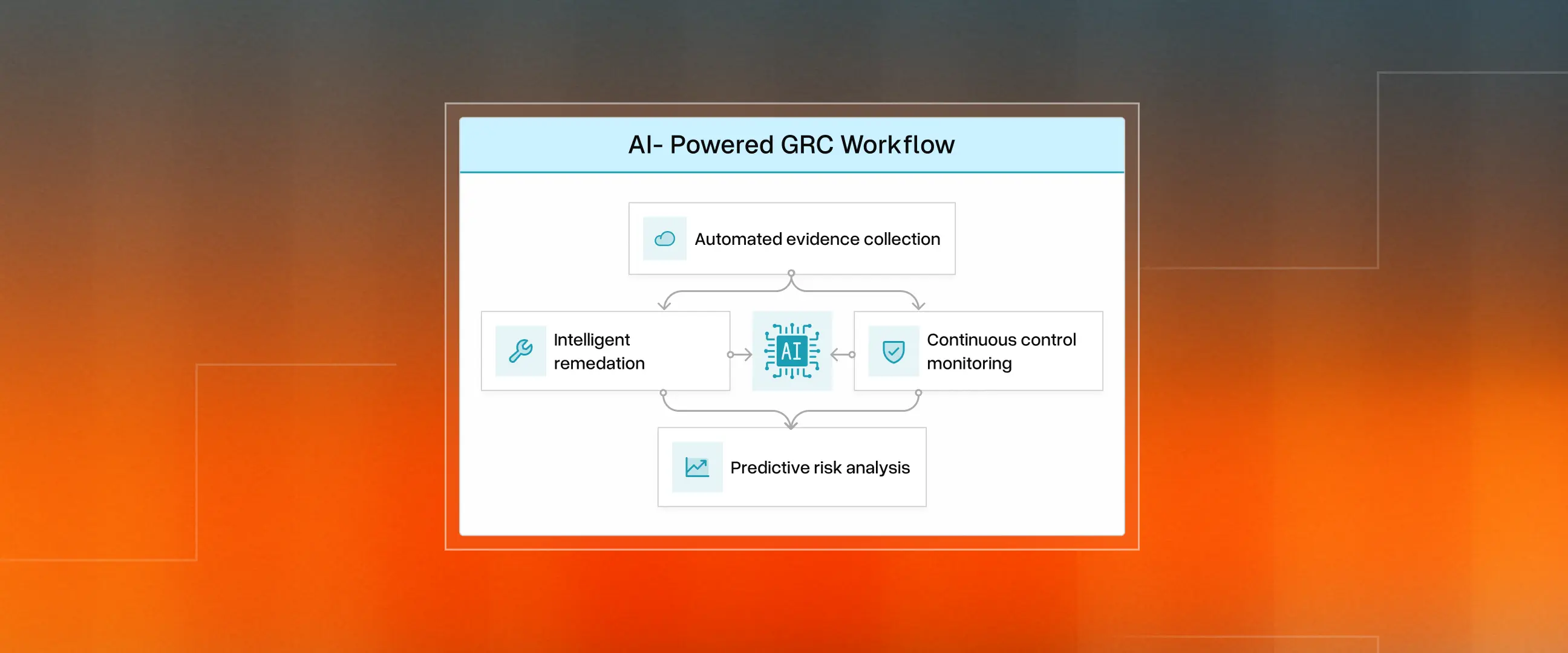
Modern AI-native compliance platforms deliver capabilities that fundamentally change how organizations maintain security posture, enabling continuous visibility rather than periodic assessments.
AI agents for Evidence Collection
Traditional compliance platforms depend on API integrations to perform compliance checks, manual screenshot uploads and periodic evidence pulls. AI-powered platforms deploy autonomous agents that navigate complex workflows, authenticate into systems, and capture compliance artifacts in real time without engineering intervention. These agents adapt to UI changes, handle multi-factor authentication flows, and extract evidence from systems that lack API access. According to the AICPA's Trust Services Criteria, SOC 2 examinations evaluate controls across security, availability, processing integrity, confidentiality, and privacy. AI agents that are tuned specifically for compliance tasks can map collected evidence directly to each criterion, eliminating the manual crosswalk that consumes hours of compliance team time.
Continuous Control Monitoring
Point-in-time assessments create compliance drift between audits. Continuous monitoring transforms periodic checks into real-time visibility. When an IAM policy changes or a cloud configuration deviates from baseline, AI systems flag the issue immediately. Gartner research predicts that by 2026, 70% of enterprises will integrate compliance as code into DevOps toolchains, reducing risk management overhead by at least 15%.
Predictive Risk Analysis
Your risk analysis is as good as your contextual awareness of your organization. Traditional GRC reports on what has already happened and can never accurately capture the risk for the organization. AI-powered platforms analyze patterns across control data, threat intelligence, and regulatory changes to forecast compliance gaps before they become audit findings. This shift from reactive to proactive risk management represents one of the most significant advances in compliance operations.
Intelligent Remediation
Compliance has its limitations and needs to function independently, however, compliance functions have the best understanding of problem and the organzational landscape. When a controls fail, AI systems can generate specific remediation guidance tailored to your environment rather than generic best practices. This precision reduces mean time to remediation and ensures fixes address root causes.
The Regulatory Landscape Driving AI Adoption in 2026
Compliance requirements are expanding faster than teams can scale. Understanding the regulatory context explains why AI automation has become essential.
European Union’s AI Act Implementation
The European Union’s AI Act entered into force in August 2024, with rules for high-risk AI systems taking effect in August 2026. Organizations must implement risk management systems, maintain technical documentation, and ensure human oversight. AI-powered compliance platforms can address these requirements systematically. Otherwise they may risk delayed EU market entry.
NIST AI Risk Management Framework
The NIST AI Risk Management Framework provides voluntary guidance through four core functions: Govern, Map, Measure, and Manage. The accompanying Playbook offers practical actions for achieving each outcome, increasingly recognized as best practice for responsible AI governance.
ISO 42001 AI Management System
ISO/IEC 42001 represents the first international standard for AI management systems, specifying requirements for establishing, implementing, and improving AI governance within organizations. Certification demonstrates commitment to responsible AI development and prepares organizations for regulatory requirements such as the EU AI Act.
Expanding Framework Requirements
Beyond AI-specific regulations, traditional compliance frameworks continue evolving. SOC 2 remains essential for B2B SaaS companies pursuing enterprise deals. ISO 27001 adoption is accelerating, with research indicating 81% of organizations report current or planned certification in 2025. HIPAA, GDPR, PCI DSS, and industry-specific requirements add complexity. Managing this multi-framework environment manually creates unsustainable workloads.
AI-Native vs. AI-Bolted: Understanding the Difference
Not all AI-powered compliance claims deliver equal value. Understanding the distinction helps organizations evaluate solutions effectively.
AI-Native Platforms
Platforms built with AI at their core, such as Delve, offer integrated automation across the compliance lifecycle:
- Evidence collection through browser agents and API integrations.
- Security questionnaire completion in minutes rather than days.
- AI-guided remediation with environment-specific instructions.
- Code scanning integrated into CI/CD workflows.
AI-Bolted Systems
These are legacy platforms that add-on AI features to their previous systems often exhibiting limitations such as:
- AI capabilities restricted to specific modules.
- Manual processes still required for core evidence collection.
- Automation that simplifies but does not eliminate engineering overhead.
The Practical Difference
For organizations with baseline security hygiene, AI-native platforms achieve audit readiness in 10-15 hours of platform interaction. Legacy systems may require 60-80 hours of engineering time for similar outcomes.

Compliance Blocking Revenue?
One should match urgency to capability, particularly organizations facing immediate compliance requirements. If an enterprise deal is blocked due to pending SOC 2 certification, prioritise platforms with demonstrated speed-to-compliance. If you are building toward future requirements, then evaluate broader framework coverage and integration depth.
The transition from manual compliance to AI-driven automation shifts compliance from a periodic burden that consumes engineering resources to a continuous practice that enhances the security posture. When your platform monitors controls in real-time, flags drift immediately, and generates remediation guidance automatically, compliance becomes a competitive advantage rather than a tax on innovation.
Become 2026 Ready
Delve's AI-native compliance platform helps organizations achieve SOC 2 certification in weeks, not months, with 10-15 hours of platform interaction. Our automated evidence collection, continuous monitoring, and dedicated compliance support eliminate the engineering overhead that slows traditional compliance programs. Talk to our team to see how AI-powered compliance can unlock your next enterprise deal.
Talk to our team to see how AI-powered compliance can unlock your next enterprise deal.




Don't let manual compliance slow you down.