INDEX
SHARE THIS ARTICLE
Ready to get compliant?
Whether you're getting compliant for the first time or want to make your next audit less painful, Delve gets you across the finish line faster.
SOC 2 progress bar showing 96% completed with steps labeled Tools, Evidence, Policies, Pass audit, and Ship faster.
Abstract gradient background blending teal, black, and orange hues.
No items found.

Complete Process of PCI Compliance (2026 Guide)

Shane Peden
Partner, Risk Advisory & Assurance Services at Aprio
min read

Summary

  • The PCI compliance process consists of three steps: (1) Assess: scope your cardholder data environment and identify gaps, (2) Remediate: implement security controls and fix vulnerabilities, and (3) Report: Document and validate compliance with your acquirer.
  • Before starting, answer three classification questions: Are you a merchant or service provider? How do you accept payments (determines SAQ type)? What's your transaction volume (determines level)? These answers set your entire compliance path.
  • Your ongoing work follows the assess-remediate-report cycle: scope your CDE and map data flows, reduce scope then implement technical and process controls, complete your SAQ or ROC and submit with quarterly ASV scans.
  • Formal validation is what happens during assessment: scoping verification, sampling for large environments, compensating control review, reporting to acquirer, and clarifications as needed.
  • Scope reduction before remediation is the highest-leverage move. 
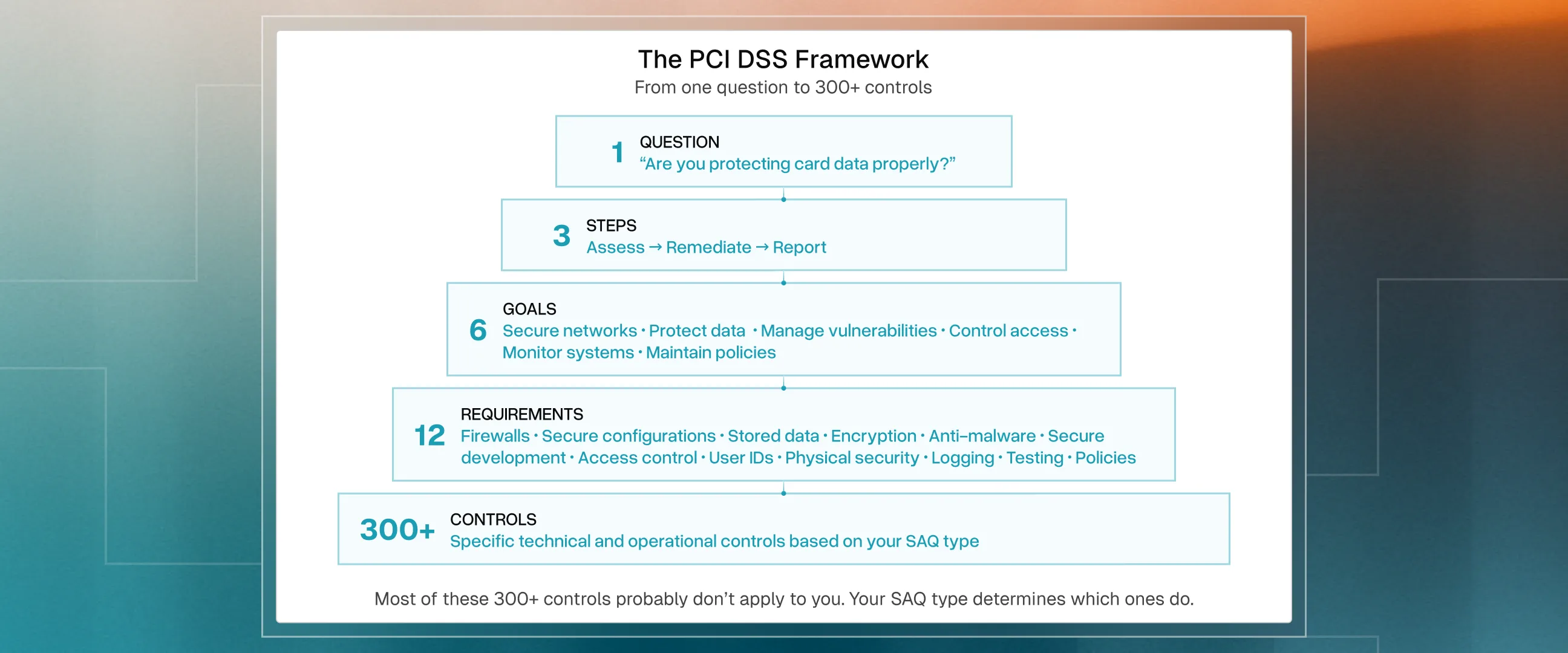
PCI DSS: How a single question drives the entire standard 

Payment Card Industry Data Security Standard (PCI DSS) often feels like an intimidating wall of 260+ controls designed for giants like JPMorgan Chase, but for most businesses, it boils down to answering just one question

“Are you protecting card data properly?”

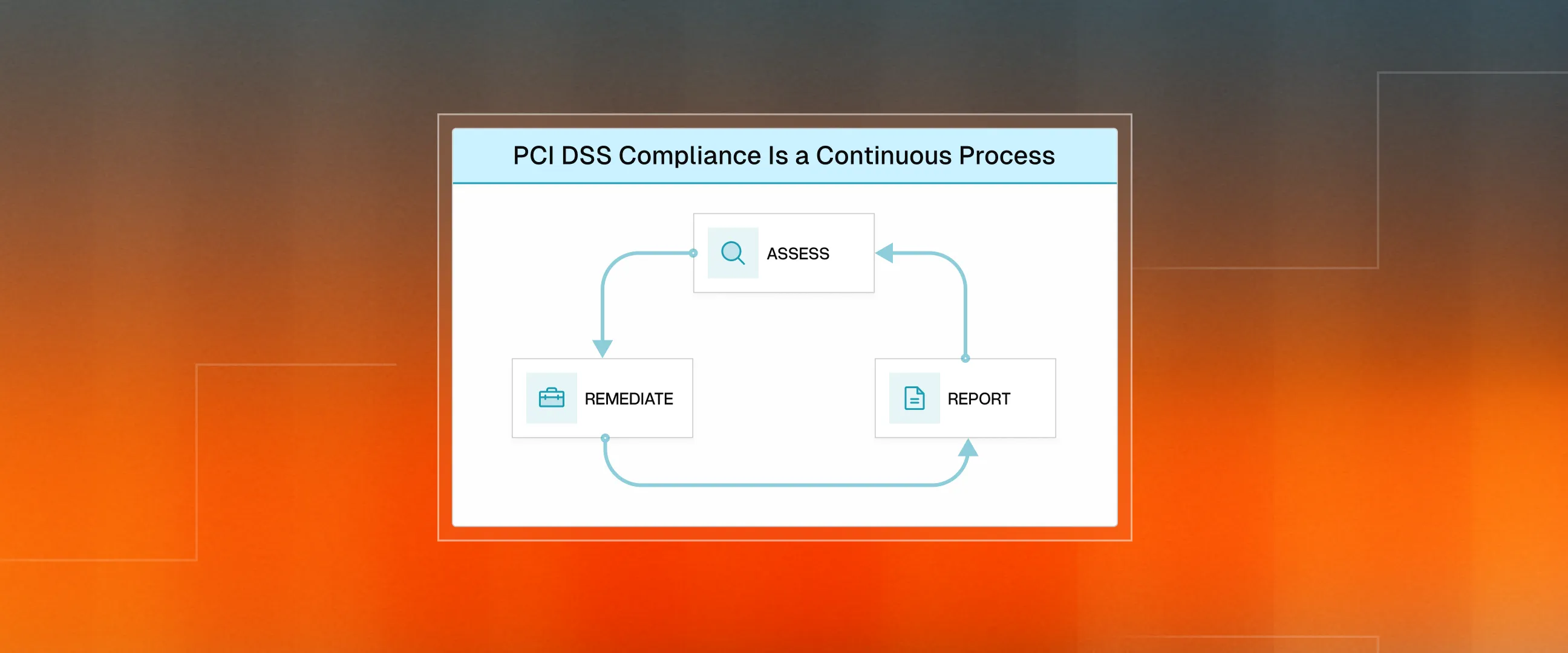
Everything else is an implementation detail. To navigate this, you simply follow an ongoing operational rhythm of three steps:
These three steps serve six core goals such as building secure networks and controlling access, which are refined into 12 mandatory requirements.

Goal Requirement
Build Secure Networks 1. Install and maintain a firewall configuration to protect cardholder data
2. Do not use vendor-supplied defaults for system passwords and other security parameters
Protect Cardholder Data 3. Protect stored data
4. Encrypt transmission of cardholder data across open, public networks
Manage Vulnerabilities 5. Use and regularly update anti-virus software or programs
6. Develop and maintain secure systems and applications
Control Access 7. Restrict access to cardholder data by business need-to-know
8. Assign a unique ID to each person with computer access
9. Restrict physical access to cardholder data
Monitor and Test 10. Track and monitor all access to network resources and cardholder data
11. Regularly test security systems and processes
Security Policies 12. Maintain a policy that addresses information security for all personnel

Focusing on these 12 requirements provides enough depth to steer your team through the process. While the 260+ micro-controls can be complex, Delve handles that heavy lifting for you, providing a bespoke framework for your specific environment.

Let's review the PCI compliance process 

Here’s how you become PCI compliant in three simple steps.
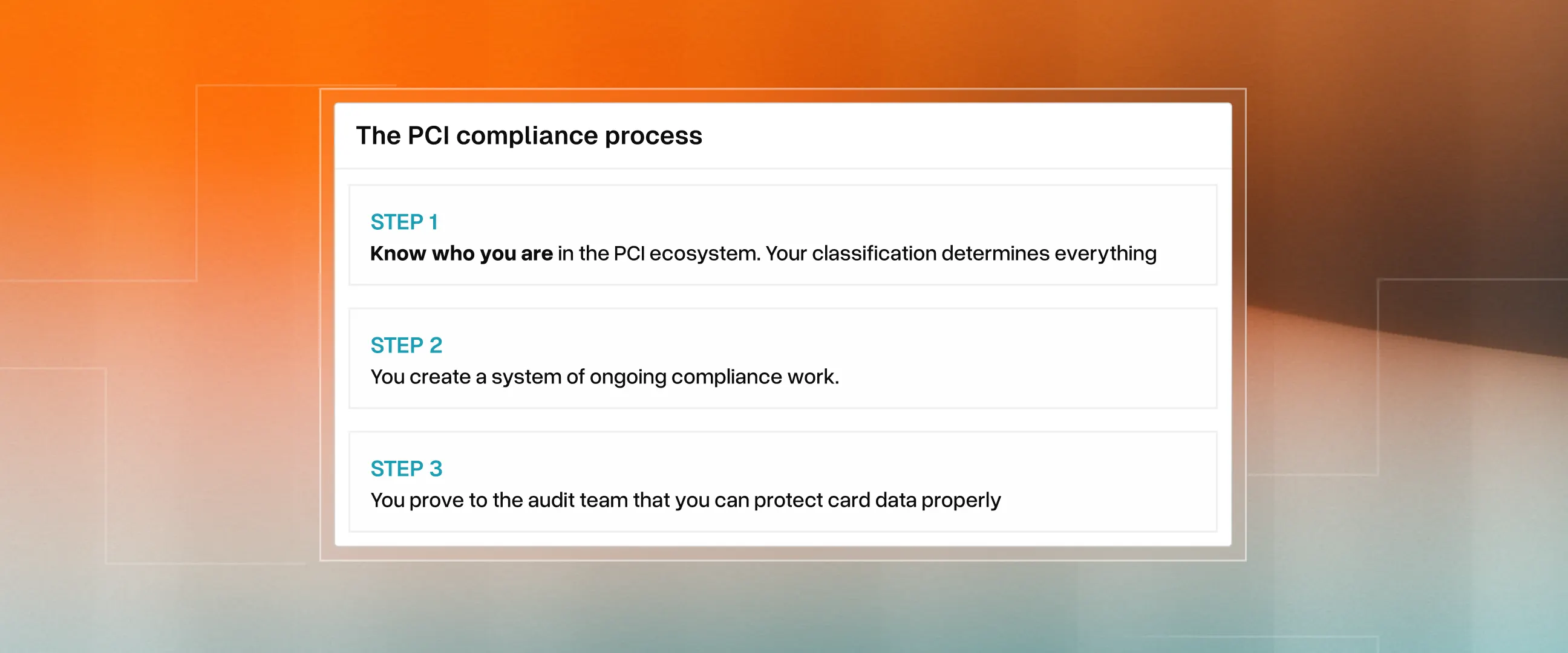
Step 1: Know who you are (before you start)

The PCI compliance journey is different for everyone. The process you follow depends on WHO you are in the PCI ecosystem. The better clarity you have of your identity, the better scope you’ll be able to draw, the less friction you’ll feel along the way. In order for that, you must answer three basic questions before doing anything else.

Question 1: Are You a Merchant or a Service Provider?

  • A merchant accepts payment cards for their own goods or services. 
  • A service provider handles cardholder data on behalf of other companies. 

Most startups are merchants. If you're selling software and taking payment, you're a merchant. If you're processing payments for other businesses or storing their customers' card data, you're a service provider. Some companies are both, which means separate compliance tracks for each role.

Why it matters

Service providers face stricter requirements and only qualify for SAQ D (the longest form). They also need to validate scope every six months instead of annually. Merchants have more options depending on how they accept payments.

Question 2: How Do You Accept Payments?

This is the big one. Your payment architecture determines which Self-Assessment Questionnaire applies to you, and SAQ types range from 22 controls to 260+. The difference between SAQ A and SAQ D isn't trivial. It's the difference between a two-week project and a six-month odyssey.

How You Accept Payments SAQ Type Controls
Fully outsourced (customer redirects to Stripe, PayPal, etc.) SAQ A ~22
E-commerce where you control the payment page SAQ A-EP ~139-191
Physical terminals connected to phone lines SAQ B ~41
Physical terminals connected to internet SAQ B-IP ~82
Virtual terminal (manually keying cards into web app) SAQ C-VT ~79
Payment app connected to internet SAQ C ~160
Point-to-point encryption hardware SAQ P2PE ~33
Everyone else (or service providers) SAQ D ~260+

Read that table again. A company using Stripe Checkout (full redirect) answers 22 questions. A company that built its own payment form answers 260+. Same business models can have wildly different compliance burdens. This is why payment architecture decisions made early in a company's life have massive downstream consequences.

One caveat: PCI DSS 4.0 added Requirements 6.4.3 and 11.6.1, which require monitoring scripts on any page containing a payment iframe. So even SAQ A merchants have some technical work now. But it's still dramatically less than handling cards directly.

Question 3: How Many Transactions Do You Process?

Transaction volume determines your "PCI compliance level," which affects how you validate compliance.

Level Annual Card Transactions What You Submit
1 Over 6 million QSA audit (Report on Compliance) + quarterly scans
2 1 million to 6 million SAQ + quarterly scans
3 20,000 to 1 million (e-commerce) SAQ + quarterly scans
4 Under 20,000 (e-commerce) or under 1 million SAQ + quarterly scans (recommended)

Most startups are Level 3 or 4. The critical threshold is 6 million transactions, where you must hire a Qualified Security Assessor (QSA) for an on-site audit. Below that, self-assessment works. Your acquirer (the bank behind your payment processor) can also bump you to a higher level based on risk factors, so don't assume volume is the only consideration.

Step 2: Create a System of Ongoing Compliance Work

Once you know your classification, you must build the "operating rhythm" that keeps you compliant. This is not a one-time event, but a continuous cycle of three phases: Assess, Remediate, and Report.

TL;DR

Founder’s Summary

Goal: Move from "not compliant" to "audit-ready" through a continuous cycle.

The Loop: You create a system that finds gaps (Assess), fixes them (Remediate), and submits proof (Report).

Key Action: Always “shrink your scope" before fixing things, to save months of work and thousands of dollars.

Assessment Phase: Find where the data lives and what’s broken 

The purpose of the assessment phase is to understand what you're protecting and where the gaps are. This phase establishes your scope (the systems that touch card data), which determines everything that follows. Rush it, and you'll pay for it later.

1. Scope your Cardholder Data Environment (CDE)

Your CDE is every system that touches card data, plus everything connected to those systems. The PCI Security Standards Council recommends assuming everything is in-scope until proven otherwise. Here's what you need to identify:

  • Every system that stores, processes, or transmits cardholder data (your payment servers, databases, applications)
  • "Connected-to" systems: anything with network connectivity to your CDE (that admin workstation on the same VLAN? In scope)
  • "Security-impacting" systems: anything that could affect CDE security if compromised (firewalls, logging servers, authentication systems)
  • Network segmentation status: document whether your CDE is isolated or sitting on a flat network (flat networks dramatically expand scope)

2. Map cardholder data flows

Draw this out. Literally. Data flow diagrams aren't just documentation requirements. They're how you find scope creep before it finds you. Answer these questions:

  • How does card data enter your environment? (Web form, API, phone call, physical terminal)
  • Where does it travel? (Which systems touch it, which networks carry it?)
  • Where is it stored, if anywhere? (Databases, logs, backups, call recordings)
  • How does it exit? (To processor, to acquirer, deleted after authorization)

3. Analyze gaps against applicable requirements

Now compare your current state to what your SAQ requires. Every "no" answer is a gap. Every gap needs a plan.

  • Compare current state to your applicable SAQ requirements (not the full PCI DSS if you qualify for a shorter SAQ)
  • Identify technical gaps: missing encryption, weak access controls, insufficient logging, unpatched systems
  • Identify process gaps: missing policies, no security training, no incident response plan, no vendor management
  • Prioritize by risk (what could cause a breach) and effort (what can you fix quickly). Quick wins build momentum.

4. Verify third-party compliance

Your vendors' compliance gaps become your compliance gaps. Don't skip this.

  • Collect Attestations of Compliance (AOCs) from every service provider who touches card data on your behalf
  • Confirm their compliance actually covers the services they provide you (an AOC for their hosted product doesn't cover custom integrations)

Remediation Phase: Shrink your scope, then fix what remains

Remediation addresses the gaps identified during assessment. The order matters here. Most companies jump straight to implementing controls. Smart companies shrink scope first.

1. Reduce the scope first of all

Before you fix anything, ask: "Can we reduce what needs fixing?" According to Google Cloud's PCI architecture guidance , one should keep narrow scopes. Overscoping leads to broad costs. Through diligent evaluation, one can avoid systems that should not be in-scope. Check for:

  • Network segmentation: Isolate your CDE on its own network segment with strict firewall rules. Everything outside the segment drops out of scope.
  • Tokenization: Replace card numbers with meaningless tokens. Systems that only see tokens are out of scope.
  • Migration to compliant third-party processors: Move card handling to a PCI-compliant provider. You inherit their compliance.
  • P2PE deployment: Point-to-point encryption encrypts card data at the terminal. Your systems never see unencrypted data.

2. Cater technical remediations

Now implement the technical controls your SAQ requires. Common items:

  • Firewall configuration and rule review: Default deny, explicit allows only for required traffic
  • Encryption implementation: TLS 1.2+ for data in transit, AES-256 for data at rest
  • Access control: PCI DSS 4.0 requires MFA for all CDE access, not just remote
  • Logging and monitoring setup: Centralized logging, real-time alerting, audit trails for all access
  • Vulnerability scanning configuration: Internal and external scans, automated and scheduled
  • Penetration testing: Required annually and after significant changes for most SAQ types

3. Implement process remediations

Technical controls aren't enough. PCI compliance requires documented processes and trained people.

  • Policy development: Information security policy, acceptable use policy, access control policy, change management policy
  • Incident response plan creation: Documented procedures for detecting, responding to, and recovering from security incidents
  • Security awareness training program: Annual training for all staff, with records of completion
  • Vendor management procedures: Process for evaluating and monitoring third-party security

4. Create documentation along

Evidence is the currency of compliance. Document as you go, not after.

  • Document all controls implemented with screenshots, configuration exports, and timestamps
  • Maintain evidence for each requirement: auditors will ask for proof, not promises
  • Keep policies and procedures current: outdated documentation is a finding

Reporting Phase: Prove the work, then keep proving it

The reporting phase validates and documents your compliance status. This is where you prove everything you've done actually meets requirements.

1. Complete your assessment

2. Sign Attestation of Compliance (AOC)

  • Formal declaration that you've completed assessment and met applicable requirements
  • Must be signed by an executive officer (for SAQ) or QSA (for ROC)

3. Conduct quarterly ASV scans

  • External vulnerability scans by an Approved Scanning Vendor (ASV) are required quarterly
  • Scans must pass: no high-severity vulnerabilities on internet-facing systems

4. Submit documentation

  • Send SAQ (or ROC) + AOC + ASV scan reports to your acquirer
  • Card brands may have additional submission requirements depending on your level and history

5. Maintain ongoing compliance

Compliance isn't a finish line. It's an operating rhythm. This system you created needs to keep running properly so that the answer to the question, “are you handling card data properly?” is always YES.

  • This cycle repeats continuously, with annual reassessment required
  • Annual reassessment required: full SAQ or ROC every 12 months
  • Re-assess after significant changes: new payment methods, major infrastructure changes, acquisitions

Step 3: Proving it to the auditor

Your ongoing compliance work is what you do. Formal validation is what happens to it. When you submit your SAQ or undergo a QSA audit, assessors step in to verify the system you've created actually works.

This isn't a separate track running parallel to your ongoing work. It's what happens inside the Report phase when an external party steps in to verify your compliance.

Step What Happens Who Does It
Scoping Verify all systems handling card data are identified and included You: SAQ
QSA: ROC
Sampling For large environments, select representative systems to test in detail QSA (for ROC only)
Compensating Controls Document and validate alternative controls when you can't meet a requirement exactly You document, QSA validates
Reporting Complete and submit required documentation to acquirer You submit
Clarifications Respond to questions from acquirer or card brands You respond as needed

Roadmap of PCI compliance process

For a startup with modern cloud infrastructure, no legacy systems, and willingness to move fast, here's what a realistic timeline looks like. SAQ A through SAQ C scenarios typically take 8-10 weeks. SAQ D with a large environment? Double or triple it. Level 1 requiring a QSA audit? Add scheduling delays and more extensive evidence collection. But the sequence stays the same.
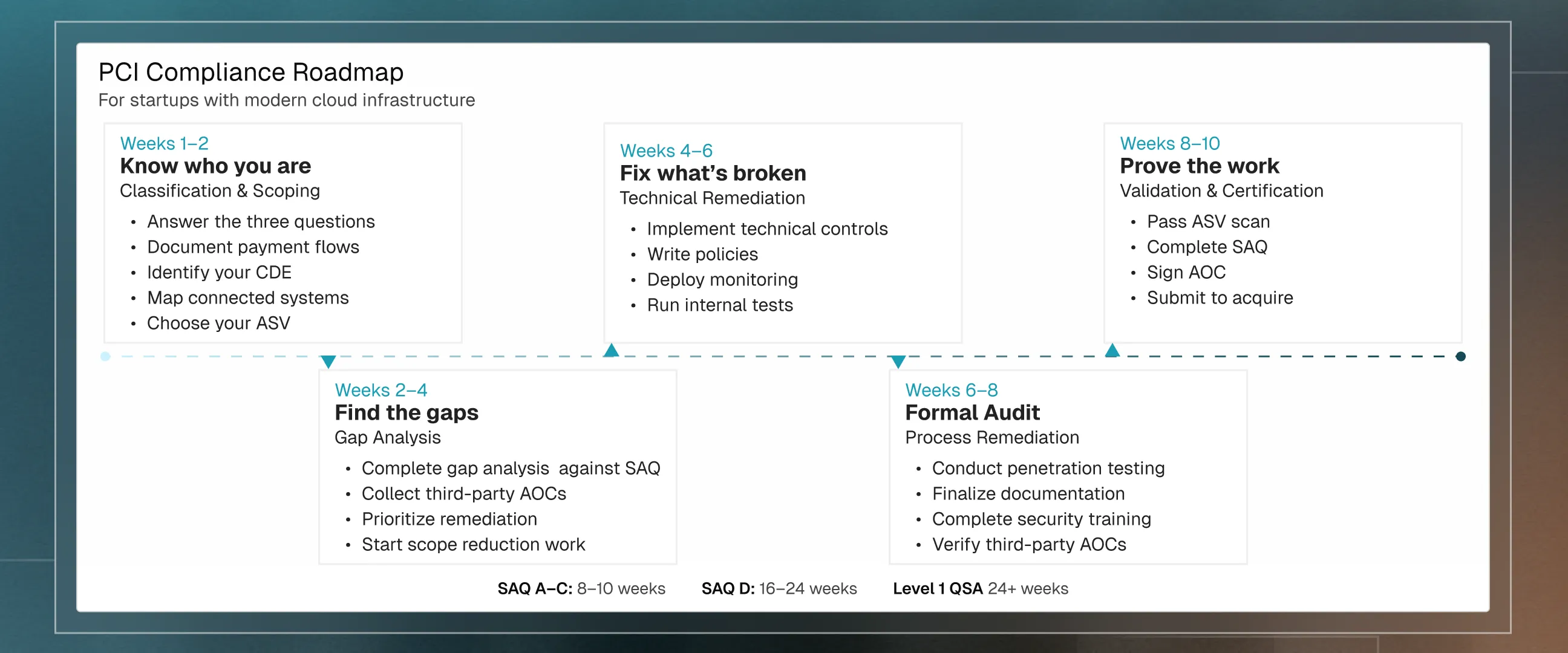
Operationalizing the sequence: Classify, shrink, and handle

PCI compliance can feel overwhelming because it's often presented as a wall of requirements. It's not. It's a sequence: classify yourself, shrink your scope, handle what remains. That sequence, executed with discipline, turns a months-long slog into a weeks-long sprint, especially with tools like Delve that were built for this exact process.

If an enterprise deal is waiting on your compliance, or you'd rather get ahead of the inevitable security questionnaire, we can help you move from zero to certified in weeks. 

About the authors

Shane Peden
Partner, Risk Advisory & Assurance Services at Aprio

Summary

  • The PCI compliance process consists of three steps: (1) Assess: scope your cardholder data environment and identify gaps, (2) Remediate: implement security controls and fix vulnerabilities, and (3) Report: Document and validate compliance with your acquirer.
  • Before starting, answer three classification questions: Are you a merchant or service provider? How do you accept payments (determines SAQ type)? What's your transaction volume (determines level)? These answers set your entire compliance path.
  • Your ongoing work follows the assess-remediate-report cycle: scope your CDE and map data flows, reduce scope then implement technical and process controls, complete your SAQ or ROC and submit with quarterly ASV scans.
  • Formal validation is what happens during assessment: scoping verification, sampling for large environments, compensating control review, reporting to acquirer, and clarifications as needed.
  • Scope reduction before remediation is the highest-leverage move. 

PCI DSS: How a single question drives the entire standard 

Payment Card Industry Data Security Standard (PCI DSS) often feels like an intimidating wall of 260+ controls designed for giants like JPMorgan Chase, but for most businesses, it boils down to answering just one question

“Are you protecting card data properly?”

Everything else is an implementation detail. To navigate this, you simply follow an ongoing operational rhythm of three steps:

These three steps serve six core goals such as building secure networks and controlling access, which are refined into 12 mandatory requirements.

Goal Requirement
Build Secure Networks 1. Install and maintain a firewall configuration to protect cardholder data
2. Do not use vendor-supplied defaults for system passwords and other security parameters
Protect Cardholder Data 3. Protect stored data
4. Encrypt transmission of cardholder data across open, public networks
Manage Vulnerabilities 5. Use and regularly update anti-virus software or programs
6. Develop and maintain secure systems and applications
Control Access 7. Restrict access to cardholder data by business need-to-know
8. Assign a unique ID to each person with computer access
9. Restrict physical access to cardholder data
Monitor and Test 10. Track and monitor all access to network resources and cardholder data
11. Regularly test security systems and processes
Security Policies 12. Maintain a policy that addresses information security for all personnel

Focusing on these 12 requirements provides enough depth to steer your team through the process. While the 260+ micro-controls can be complex, Delve handles that heavy lifting for you, providing a bespoke framework for your specific environment.

Let's review the PCI compliance process 

Here’s how you become PCI compliant in three simple steps.

Step 1: Know who you are (before you start)

The PCI compliance journey is different for everyone. The process you follow depends on WHO you are in the PCI ecosystem. The better clarity you have of your identity, the better scope you’ll be able to draw, the less friction you’ll feel along the way. In order for that, you must answer three basic questions before doing anything else.

Question 1: Are You a Merchant or a Service Provider?

  • A merchant accepts payment cards for their own goods or services. 
  • A service provider handles cardholder data on behalf of other companies. 

Most startups are merchants. If you're selling software and taking payment, you're a merchant. If you're processing payments for other businesses or storing their customers' card data, you're a service provider. Some companies are both, which means separate compliance tracks for each role.

Why it matters

Service providers face stricter requirements and only qualify for SAQ D (the longest form). They also need to validate scope every six months instead of annually. Merchants have more options depending on how they accept payments.

Question 2: How Do You Accept Payments?

This is the big one. Your payment architecture determines which Self-Assessment Questionnaire applies to you, and SAQ types range from 22 controls to 260+. The difference between SAQ A and SAQ D isn't trivial. It's the difference between a two-week project and a six-month odyssey.

How You Accept Payments SAQ Type Controls
Fully outsourced (customer redirects to Stripe, PayPal, etc.) SAQ A ~22
E-commerce where you control the payment page SAQ A-EP ~139-191
Physical terminals connected to phone lines SAQ B ~41
Physical terminals connected to internet SAQ B-IP ~82
Virtual terminal (manually keying cards into web app) SAQ C-VT ~79
Payment app connected to internet SAQ C ~160
Point-to-point encryption hardware SAQ P2PE ~33
Everyone else (or service providers) SAQ D ~260+

Read that table again. A company using Stripe Checkout (full redirect) answers 22 questions. A company that built its own payment form answers 260+. Same business models can have wildly different compliance burdens. This is why payment architecture decisions made early in a company's life have massive downstream consequences.

One caveat: PCI DSS 4.0 added Requirements 6.4.3 and 11.6.1, which require monitoring scripts on any page containing a payment iframe. So even SAQ A merchants have some technical work now. But it's still dramatically less than handling cards directly.

Question 3: How Many Transactions Do You Process?

Transaction volume determines your "PCI compliance level," which affects how you validate compliance.

Level Annual Card Transactions What You Submit
1 Over 6 million QSA audit (Report on Compliance) + quarterly scans
2 1 million to 6 million SAQ + quarterly scans
3 20,000 to 1 million (e-commerce) SAQ + quarterly scans
4 Under 20,000 (e-commerce) or under 1 million SAQ + quarterly scans (recommended)

Most startups are Level 3 or 4. The critical threshold is 6 million transactions, where you must hire a Qualified Security Assessor (QSA) for an on-site audit. Below that, self-assessment works. Your acquirer (the bank behind your payment processor) can also bump you to a higher level based on risk factors, so don't assume volume is the only consideration.

Step 2: Create a System of Ongoing Compliance Work

Once you know your classification, you must build the "operating rhythm" that keeps you compliant. This is not a one-time event, but a continuous cycle of three phases: Assess, Remediate, and Report.

TL;DR

Founder’s Summary

Goal: Move from "not compliant" to "audit-ready" through a continuous cycle.

The Loop: You create a system that finds gaps (Assess), fixes them (Remediate), and submits proof (Report).

Key Action: Always “shrink your scope" before fixing things, to save months of work and thousands of dollars.

Assessment Phase: Find where the data lives and what’s broken 

The purpose of the assessment phase is to understand what you're protecting and where the gaps are. This phase establishes your scope (the systems that touch card data), which determines everything that follows. Rush it, and you'll pay for it later.

1. Scope your Cardholder Data Environment (CDE)

Your CDE is every system that touches card data, plus everything connected to those systems. The PCI Security Standards Council recommends assuming everything is in-scope until proven otherwise. Here's what you need to identify:

  • Every system that stores, processes, or transmits cardholder data (your payment servers, databases, applications)
  • "Connected-to" systems: anything with network connectivity to your CDE (that admin workstation on the same VLAN? In scope)
  • "Security-impacting" systems: anything that could affect CDE security if compromised (firewalls, logging servers, authentication systems)
  • Network segmentation status: document whether your CDE is isolated or sitting on a flat network (flat networks dramatically expand scope)

2. Map cardholder data flows

Draw this out. Literally. Data flow diagrams aren't just documentation requirements. They're how you find scope creep before it finds you. Answer these questions:

  • How does card data enter your environment? (Web form, API, phone call, physical terminal)
  • Where does it travel? (Which systems touch it, which networks carry it?)
  • Where is it stored, if anywhere? (Databases, logs, backups, call recordings)
  • How does it exit? (To processor, to acquirer, deleted after authorization)

3. Analyze gaps against applicable requirements

Now compare your current state to what your SAQ requires. Every "no" answer is a gap. Every gap needs a plan.

  • Compare current state to your applicable SAQ requirements (not the full PCI DSS if you qualify for a shorter SAQ)
  • Identify technical gaps: missing encryption, weak access controls, insufficient logging, unpatched systems
  • Identify process gaps: missing policies, no security training, no incident response plan, no vendor management
  • Prioritize by risk (what could cause a breach) and effort (what can you fix quickly). Quick wins build momentum.

4. Verify third-party compliance

Your vendors' compliance gaps become your compliance gaps. Don't skip this.

  • Collect Attestations of Compliance (AOCs) from every service provider who touches card data on your behalf
  • Confirm their compliance actually covers the services they provide you (an AOC for their hosted product doesn't cover custom integrations)

Remediation Phase: Shrink your scope, then fix what remains

Remediation addresses the gaps identified during assessment. The order matters here. Most companies jump straight to implementing controls. Smart companies shrink scope first.

1. Reduce the scope first of all

Before you fix anything, ask: "Can we reduce what needs fixing?" According to Google Cloud's PCI architecture guidance , one should keep narrow scopes. Overscoping leads to broad costs. Through diligent evaluation, one can avoid systems that should not be in-scope. Check for:

  • Network segmentation: Isolate your CDE on its own network segment with strict firewall rules. Everything outside the segment drops out of scope.
  • Tokenization: Replace card numbers with meaningless tokens. Systems that only see tokens are out of scope.
  • Migration to compliant third-party processors: Move card handling to a PCI-compliant provider. You inherit their compliance.
  • P2PE deployment: Point-to-point encryption encrypts card data at the terminal. Your systems never see unencrypted data.

2. Cater technical remediations

Now implement the technical controls your SAQ requires. Common items:

  • Firewall configuration and rule review: Default deny, explicit allows only for required traffic
  • Encryption implementation: TLS 1.2+ for data in transit, AES-256 for data at rest
  • Access control: PCI DSS 4.0 requires MFA for all CDE access, not just remote
  • Logging and monitoring setup: Centralized logging, real-time alerting, audit trails for all access
  • Vulnerability scanning configuration: Internal and external scans, automated and scheduled
  • Penetration testing: Required annually and after significant changes for most SAQ types

3. Implement process remediations

Technical controls aren't enough. PCI compliance requires documented processes and trained people.

  • Policy development: Information security policy, acceptable use policy, access control policy, change management policy
  • Incident response plan creation: Documented procedures for detecting, responding to, and recovering from security incidents
  • Security awareness training program: Annual training for all staff, with records of completion
  • Vendor management procedures: Process for evaluating and monitoring third-party security

4. Create documentation along

Evidence is the currency of compliance. Document as you go, not after.

  • Document all controls implemented with screenshots, configuration exports, and timestamps
  • Maintain evidence for each requirement: auditors will ask for proof, not promises
  • Keep policies and procedures current: outdated documentation is a finding

Reporting Phase: Prove the work, then keep proving it

The reporting phase validates and documents your compliance status. This is where you prove everything you've done actually meets requirements.

1. Complete your assessment

2. Sign Attestation of Compliance (AOC)

  • Formal declaration that you've completed assessment and met applicable requirements
  • Must be signed by an executive officer (for SAQ) or QSA (for ROC)

3. Conduct quarterly ASV scans

  • External vulnerability scans by an Approved Scanning Vendor (ASV) are required quarterly
  • Scans must pass: no high-severity vulnerabilities on internet-facing systems

4. Submit documentation

  • Send SAQ (or ROC) + AOC + ASV scan reports to your acquirer
  • Card brands may have additional submission requirements depending on your level and history

5. Maintain ongoing compliance

Compliance isn't a finish line. It's an operating rhythm. This system you created needs to keep running properly so that the answer to the question, “are you handling card data properly?” is always YES.

  • This cycle repeats continuously, with annual reassessment required
  • Annual reassessment required: full SAQ or ROC every 12 months
  • Re-assess after significant changes: new payment methods, major infrastructure changes, acquisitions

Step 3: Proving it to the auditor

Your ongoing compliance work is what you do. Formal validation is what happens to it. When you submit your SAQ or undergo a QSA audit, assessors step in to verify the system you've created actually works.

This isn't a separate track running parallel to your ongoing work. It's what happens inside the Report phase when an external party steps in to verify your compliance.

Step What Happens Who Does It
Scoping Verify all systems handling card data are identified and included You: SAQ
QSA: ROC
Sampling For large environments, select representative systems to test in detail QSA (for ROC only)
Compensating Controls Document and validate alternative controls when you can't meet a requirement exactly You document, QSA validates
Reporting Complete and submit required documentation to acquirer You submit
Clarifications Respond to questions from acquirer or card brands You respond as needed

Roadmap of PCI compliance process

For a startup with modern cloud infrastructure, no legacy systems, and willingness to move fast, here's what a realistic timeline looks like. SAQ A through SAQ C scenarios typically take 8-10 weeks. SAQ D with a large environment? Double or triple it. Level 1 requiring a QSA audit? Add scheduling delays and more extensive evidence collection. But the sequence stays the same.

Operationalizing the sequence: Classify, shrink, and handle

PCI compliance can feel overwhelming because it's often presented as a wall of requirements. It's not. It's a sequence: classify yourself, shrink your scope, handle what remains. That sequence, executed with discipline, turns a months-long slog into a weeks-long sprint, especially with tools like Delve that were built for this exact process.

Don't let manual compliance slow you down.

With Delve, companies prove compliance faster, close deals quicker, and stay compliant as they scale.
Abstract gradient background with vertical rectangular segments blending from teal on the left to dark, then orange on the right.

How to build and run a billboard campaign

Dark gradient background transitioning from warm brown tones on the left to cooler blue tones on the right.